You called it an AI-pilot. Your employees heard: "this can wait"
Every tech rollout sends a message. The question is which one.

Written by**: Bella Funck**, Co-Founder & CEO
The pilot trap
The AI pilot kicks off.
A group joins a kickoff call. The tool gets demoed, a few use cases are shown, and your people say, “this could save us a lot of time”.
Access is shared. And you say, “Try it out over the next few months. Let us know what you think. We’ll evaluate after the summer.”
It looks like a good start.
By Tuesday, reality has taken over. Deadlines, meetings, and everything else that already fills the day. The tool is still there, but now it’s competing with work that feels urgent and important.
Some people give it a try. They run into friction. It takes longer than expected. So they step back.
A few others keep experimenting, but most return to what they know, because it’s easier to move forward with what already works under pressure.
The pilot ends. What did you really learn?
Nothing failed. But also, nothing changed.
This is what AI adoption often looks like in reality. Because the most common approach to kick off an AI adoption is also what’s holding it back.
You called it "an AI-pilot". Employees heard: "this can wait".
The numbers tell the story
Something is clearly getting lost between deployment and impact.
99% of Nordic companies have rolled out AI. Only 4% see ROI. — BCG Nordic AI Report, March 2026
The dip nobody designs for
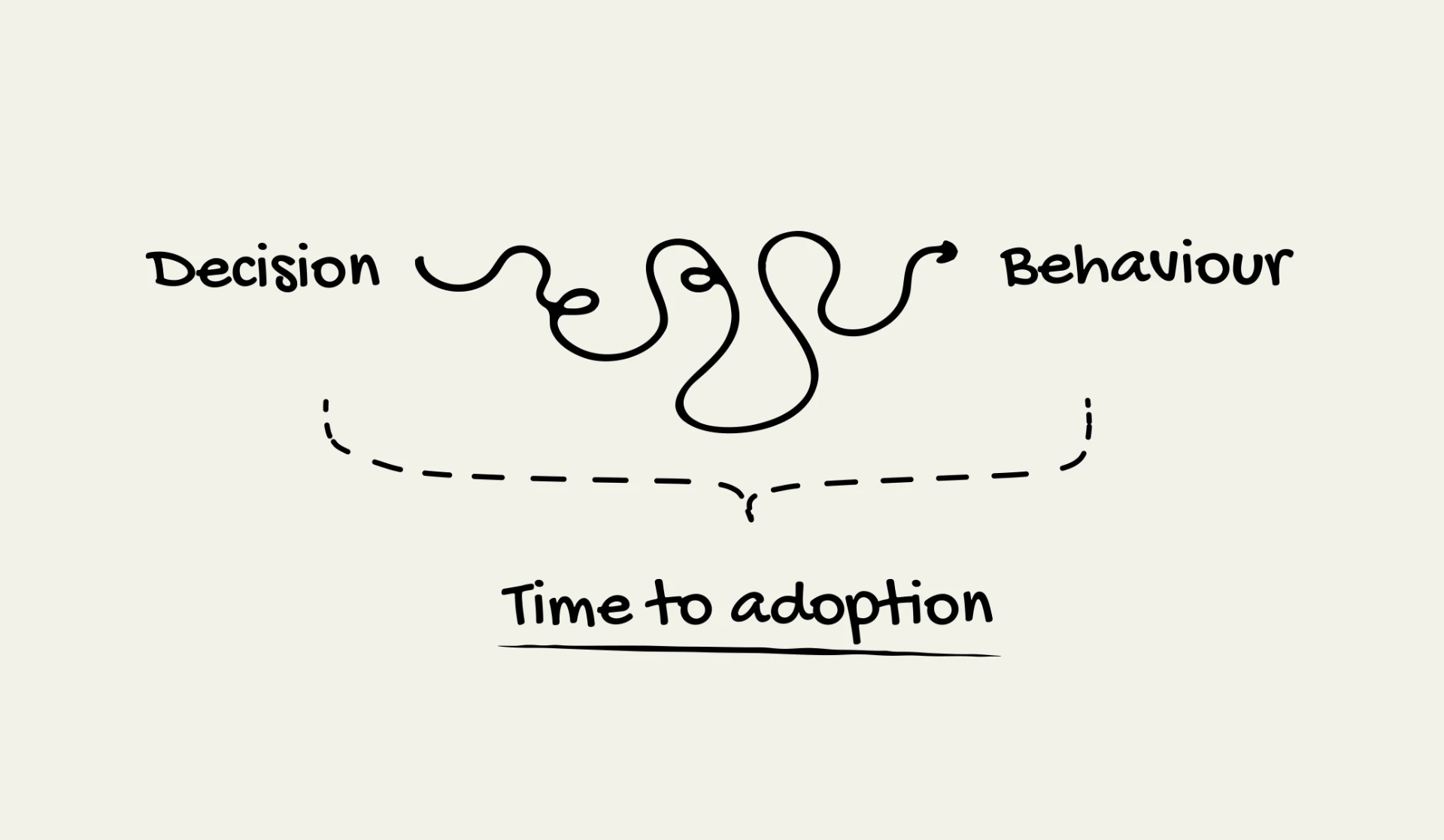
Every new technology comes with a learning curve.
Before it saves time, it costs time. Before it feels easy, it feels like extra work. There is always a dip before there's a gain.
When adoption feels optional, on the side of the real work, and when ownership is unclear, people have every reason to stay or stop in the dip.
Never pushing through to where behavior changes. Never reaching the point where the real value shows up.
What actually drives adoption
Our research collaboration with RISE, drawing on a meta-analysis of 162 studies on technology adoption, points to three things that consistently drive behavior change in this area:
- Performance expectancy: Do I personally gain something from this, in my actual work, this week?
- Attitude: Do I believe this could work for me, in my context?
- Social influence: Are people around me actually using this?
All three are shaped by the environment around the tool.
And here's the catch. The first group doesn’t enter that environment. They need to create it.
The first group sets the tone
Because they shape the proofs that influence what others will believe:
- if this is useful,
- if it works in reality,
- if it's worth the effort.
If they stay in the dip, the organization stays in the dip.
First step of adoption is driven by priority
The first phase of adoption isn’t driven by proof, it’s driven by priority. Research in motivation and organisational behaviour shows that people only invest time and effort into something new when they understand why it matters, they see clear signals that it matters, and they have the time and support to engage with it.
If any of these are missing, the rational choice is simple: go back to what already works and what feels more business crucial.
Starting small works, if you frame it right
A smaller group is often the right place to start. But they can’t be there to “try” the technology. Their role is to show what a new way of working actually looks like.
The way you frame this first phase matters more than most people think.
If it sounds like:
- “let’s do this on the side of work”
- “we’re not sure yet”
- “we’ll evaluate later”
…people treat it that way.
Instead, be clear from the start and frame it like:
- "This matters now."
- "We’re sprinting a new way of working and we expect something to come out of this."
- "Create a picture of how work could be done with this technology."
And give them the environment they need: time, support, and the understanding that the dip is expected and temporary.
If the value is real, you get the proof — the stories you need for the next phase to take off.
Momentum spreads
Behaviours are contagious.
Research shows that when one person adopts a new behaviour, the likelihood their colleagues follow is 45% (Christakis & Fowler). When someone starts working in a new way, and can show why it’s worth it, others follow.
That’s how adoption moves through an organisation. Make the good examples visible. Show what it looks like on the other side of the dip. Let momentum do the work.
The question that matters
Look at the first phase of your rollout. What does it actually signal?
- Is this something people are expected to prioritise, or something they’ll get to when they have time?
- Are managers explaining why it matters, or just that it exists?
- Are people testing a tool, or exploring a better way of working?
The first step doesn’t just start adoption. It defines whether it happens at all.
--
Bella Funck, April 2026
Join the AI Adoption Accelerator
Over 5 months, your organization drives AI adoption, with expert guidance from Johannes Sundlo, an AI system built for running change, and a cohort of organizations doing the same work.